
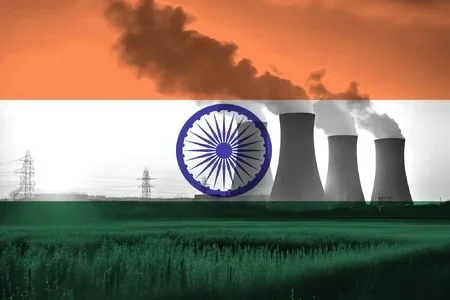
New Delhi, April 11 – India has set a major goal to expand its nuclear power capacity to at least 100 GW by 2047, marking the centenary of its independence, as it seeks to strengthen long-term energy security and reduce dependence on fossil fuels, according to a new report.
According to a report by Khaleej Times, the country currently operates 24 nuclear reactors with a combined capacity of 8,780 MWe (Megawatt electric), while eight more reactors with a capacity of 6,028 MWe are under construction.
Government projections indicate that installed nuclear capacity will rise to around 22 GW by the early 2030s before expanding sharply to meet the 100 GW target.
To achieve this more than eleven-fold increase, India is pursuing a two-pronged strategy that includes the development of large reactors – such as indigenous 700 MWe pressurized heavy water reactors (PHWRs) and imported large-capacity units at greenfield sites – alongside smaller modular systems like the 200 MWe Bharat Small Modular Reactors (BSMRs) and 55 MWe SMR-55 units, the report said.
A key milestone in this journey was achieved on April 6, 2026, when the 500 MWe Prototype Fast Breeder Reactor (PFBR) at Kalpakkam in Tamil Nadu attained first criticality – the start of a controlled nuclear fission chain reaction.
The development is being seen as a major step in advancing India’s indigenous nuclear technology and ensuring long-term fuel sustainability.
India’s nuclear programme is built around a three-stage strategy designed to maximise limited uranium resources while leveraging its vast thorium reserves.
The first stage uses PHWRs fuelled by natural uranium to produce plutonium. The second stage involves fast breeder reactors that use plutonium as fuel and generate more fissile material than they consume. The final stage aims to utilise thorium-based reactors, producing uranium-233 to sustain long-term nuclear power generation.
According to the report, the PFBR uses uranium-plutonium mixed oxide (MOX) fuel and liquid sodium as a coolant, enabling it to produce more fuel than it consumes while paving the way for eventual thorium use.
The 500 MWe reactor is capable of supplying electricity to around half a million homes.
Disclaimer: Due care and diligence have been taken in compiling and presenting news and market-related content. However, errors or omissions may arise despite such efforts.
The information provided is for general informational purposes only and does not constitute investment advice, a recommendation, or an offer to buy or sell any securities. Readers are advised to rely on their own assessment and judgment and consult appropriate financial advisers, if required, before taking any investment-related decisions.
Any views, opinions, or statements expressed, where applicable, are those of the respective analysts or experts and do not reflect the views of this website. The website has no association with such viewpoints and does not assume any responsibility for them.