
Trump Raises Third Term Prospect Despite Constitutional Bar
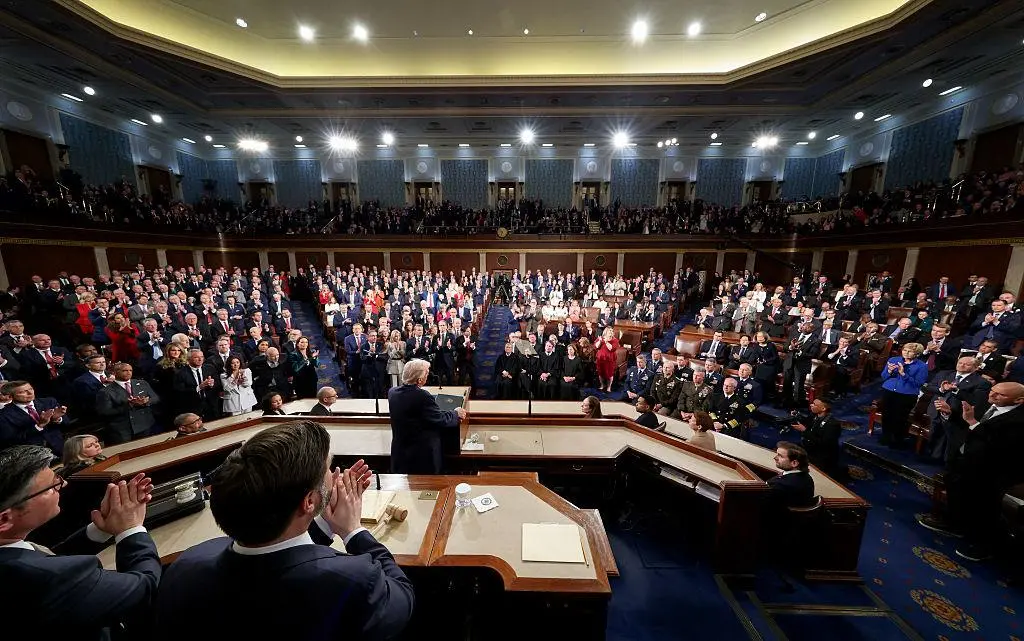
United States President Donald Trump used his State of the Union address to lay out his second term priorities while again floating the possibility of serving a third term, even though the Constitution bars it.Addressing lawmakers, Cabinet officials, and Supreme Court justices in the House chamber, Trump said, "The first year of the second term… it should be my third term. But strange things happen," drawing a mix of applause and murmurs.
The remark revived a theme he has periodically raised since returning to office. In March 2025, he told NBC News that he was "not joking" about the idea of running again in 2028. At other times, he has acknowledged, "It's pretty clear, I'm not allowed to run," and suggested that such comments were aimed at the "fake news media."
What the Constitution Says About Presidential Terms
The 22nd Amendment to the United States Constitution explicitly prohibits a president from serving more than two terms.Repealing the amendment would require approval by two thirds of both chambers of Congress and ratification by 38 states. Such a process is widely viewed as politically and practically unachievable.
The Constitution also sets eligibility requirements for the presidency. A candidate must be a natural born citizen of the United States, at least 35 years old, and a resident of the United States for 14 years. There is no upper age limit for holding the office.
Despite the constitutional barrier, Trump’s political team has embraced the symbolism. His official merchandise store began selling "Trump 2028" hats for $50 last year.
Midterm Focus: Tariffs, Retirement Savings and Housing
Beyond the third term comments, Trump used the address to focus on his economic and domestic agenda ahead of November’s midterm elections, when all 435 House seats and roughly one third of the Senate will be contested.He reiterated his push to use tariffs as a revenue tool, arguing that duties on foreign imports could serve as an alternative to income taxes for many Americans. Trump framed tariffs as a mechanism to "bring wealth back" to the United States.
The president also announced a new retirement savings initiative, presenting it as a measure to strengthen long term financial security for middle class families.
On housing, Trump pledged steps aimed at expanding supply and lowering costs. He attributed high housing prices to regulatory burdens and elevated interest rates, and signaled plans to ease federal land restrictions and reduce permitting timelines, though he offered limited specifics.
Energy Demands for Data Centres
Trump said he would ask data centre companies to generate their own electricity to prevent rising power costs for households."I'm telling them they can build their own plant. They're going to produce their own electricity," he said, arguing that such an arrangement would shield American families from higher electricity bills.
Inflation Receives Limited Attention
Notably, Trump devoted comparatively little time to directly addressing inflation and everyday cost of living pressures, issues that polling indicates remain politically sensitive.While the speech underscored his broader economic narrative and campaign messaging ahead of the midterms, the renewed third term suggestion once again placed constitutional limits at the center of the political conversation.
Disclaimer: Due care and diligence have been taken in compiling and presenting news and market-related content. However, errors or omissions may arise despite such efforts.
The information provided is for general informational purposes only and does not constitute investment advice, a recommendation, or an offer to buy or sell any securities. Readers are advised to rely on their own assessment and judgment and consult appropriate financial advisers, if required, before taking any investment-related decisions.